For years, work was done the traditional way — manual research, long editing hours, designing everything from scratch. It required time, effort, and patience.
In 2026, AI tools have changed that equation. Tasks that once took hours can now be done in minutes.
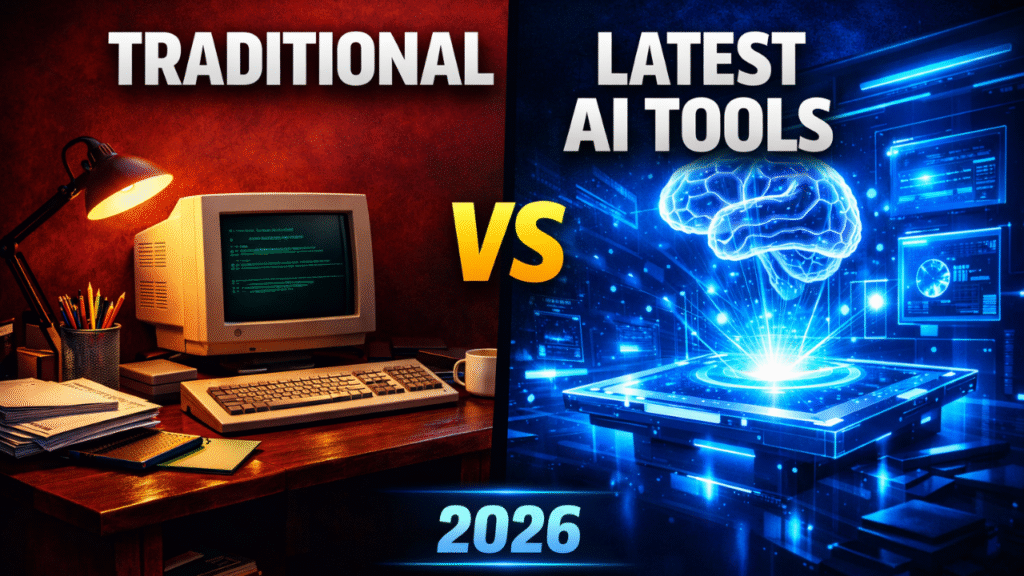
Traditional tools built the foundation.
AI tools are building speed and scale.
The question is simple — are you still working the old way, or adapting to the new one?
1. Research
- Traditional Tools: Google, Wikipedia, Microsoft Word
- AI Tools (2026): ChatGPT, Perplexity AI, Google Gemini
Earlier, research meant opening 10–15 tabs, reading multiple articles, copying notes into Word, and manually organizing everything.
It worked — but it was slow.
Now, AI tools can:
- Summarize complex topics instantly
- Compare multiple viewpoints
- Generate structured notes
- Create outlines for articles or presentations
Instead of spending 3 hours collecting information, you can get a structured draft in minutes.
But here’s the reality:
AI speeds up information processing — it does not replace critical thinking. If you don’t know what to ask, you’ll still get average results.
Smart prompts = smart research.
2. Video Editing
- Traditional Tools: Adobe Premiere Pro, Final Cut Pro
- AI Tools (2026): CapCut AI, Runway, Descript
Traditional editing required:
- Manual cutting
- Manual subtitles
- Manual sound cleanup
- Manual background removal
Now AI tools can:
- Remove background noise
- Auto-generate captions
- Convert long videos into short clips
- Generate B-roll automatically
What earlier took 6–8 hours can now take 1–2 hours.
But don’t misunderstand this shift.
- AI can edit.
- AI cannot fix boring storytelling.
If your content lacks clarity, structure, or emotional hook — no tool will save it.
3. Growing Instagram
- Traditional Method: Asking relatives to follow, random posting
- AI Tools (2026): Flick AI, ChatGPT, Canva AI Content Planner
Earlier, growth was mostly trial and error:
- Random hashtags
- No strategy
- No data
- No content calendar
Now AI can:
- Suggest trending hashtags
- Generate caption variations
- Plan weekly content calendars
- Analyze audience behavior
That sounds powerful — and it is.
But here’s the uncomfortable truth:
Most accounts don’t fail because of tools.
They fail because of inconsistency.
- AI gives you a roadmap.
- Execution is still your job.
4. Presentations
- Traditional Tools: Microsoft PowerPoint, Google Slides
- AI Tools (2026): Gamma, Tome, Canva AI
Earlier, creating a presentation meant:
- Designing slides manually
- Writing every bullet point
- Searching for images
- Adjusting layouts for hours
Now, you enter a topic and AI can generate:
- Complete slide decks
- Structured content
- Visual layouts
- Relevant design themes
- The time-saving is massive.
But understand this clearly:
A beautiful presentation cannot hide weak thinking.
If your ideas are shallow, the slides will only make them look polished — not powerful.
5. Copywriting
- Traditional Method: Manual writing, Microsoft Word
- AI Tools (2026): Jasper, Copy.ai, ChatGPT
Writing earlier required:
- Brainstorming hooks
- Drafting multiple versions
- Editing line by line
Now AI can:
- Generate headlines instantly
- Create multiple content angles
- Rewrite and optimize tone
- Improve clarity and structure
- This reduces creative block dramatically.
But there’s a catch.
- AI drafts are often average by default.
- If you publish without refining, your content will sound like everyone else using AI.
- The real skill in 2026 is not writing from scratch.
It is editing intelligently.
6. Images & Design
- Traditional Tools: Adobe Photoshop, Stock Image Websites
- AI Tools (2026): Midjourney, Leonardo AI
Earlier, you either:
- Learned complex design software
- Hired a designer
- Used generic stock images
Now you can:
- Generate custom visuals from text prompts
- Create unique thumbnails
- Design brand-specific graphics
- Produce concept art in minutes
- This removes technical barriers.
But again — prompt writing is the new design skill.
If your idea is vague, your output will be average.
7. Resume Making
- Traditional Method: MS Word Templates, Graphic Designer
- AI Tools (2026): Kickresume, Rezi, ChatGPT Resume Prompts
Earlier:
- You downloaded a template
- Filled generic content
- Hoped HR would notice
Now AI tools can:
- Optimize resumes for ATS systems
- Tailor content to specific job roles
- Improve clarity and impact
- Highlight measurable achievements
- This increases interview chances significantly.
But here’s something important:
- AI can help you present your skills.
- It cannot create real skills for you.
If you fake experience using AI, interviews will expose you instantly.
Final Reality Check: What Actually Matters in 2026
- AI tools are not replacing skilled professionals.
- But professionals who use AI effectively will outperform those who ignore it.
- Traditional tools built discipline and technical foundations.
- AI tools build speed, scale, and leverage.
The winners in 2026 will not choose one side.
- They will combine:
- Strong fundamentals
- Clear thinking
- Strategic AI usage
AI is not magic.
It is a multiplier.
If your base is weak, AI multiplies weakness.
If your base is strong, AI multiplies results.
The decision is yours — stay manual and slow, or adapt and accelerate.
Want to Learn AI Tools? Join my complete course [Click Below Link]
Bundle of 20 AI tools to increase your Productivity and income